
Modern Men’s Work
A field guide to a quiet practice in a loud time

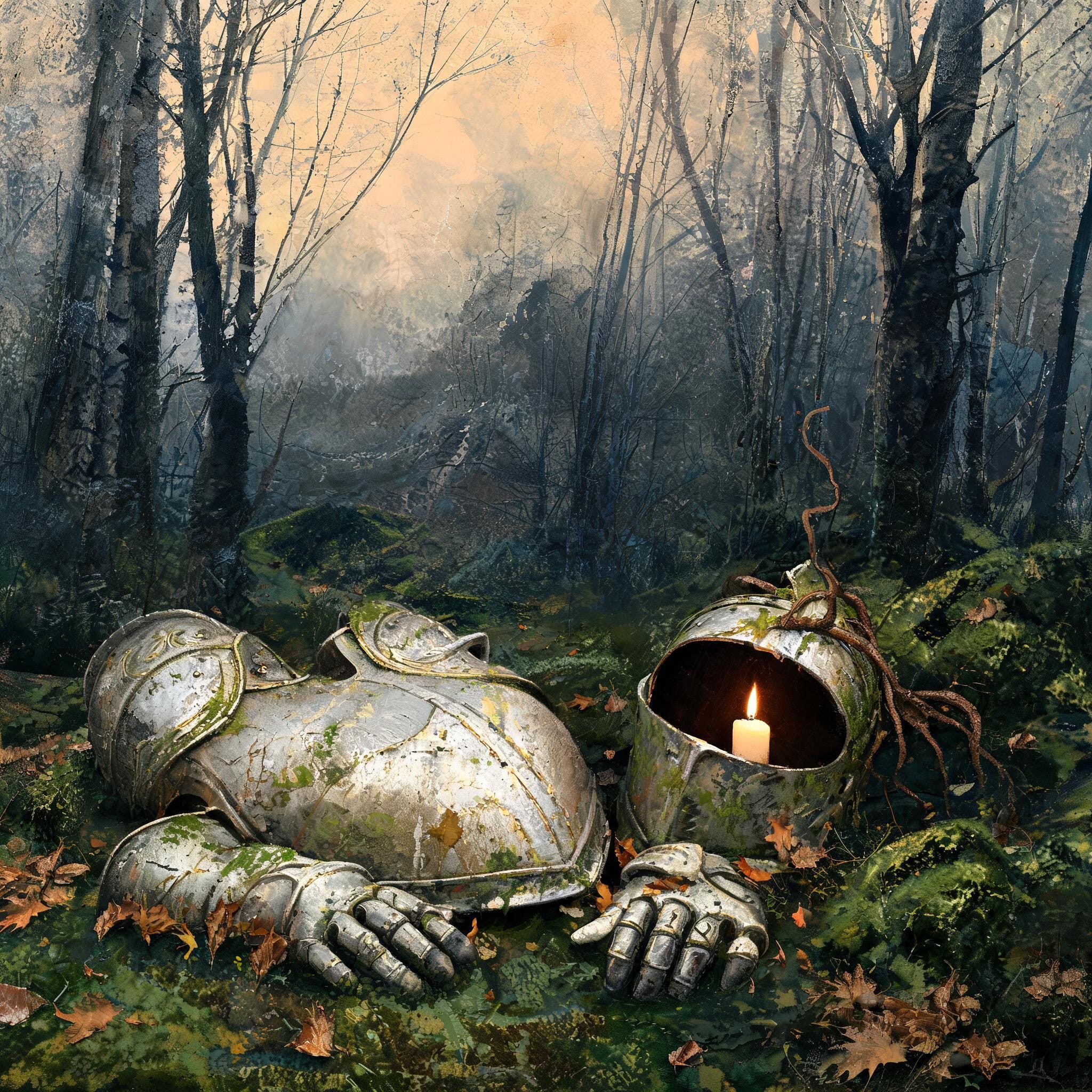
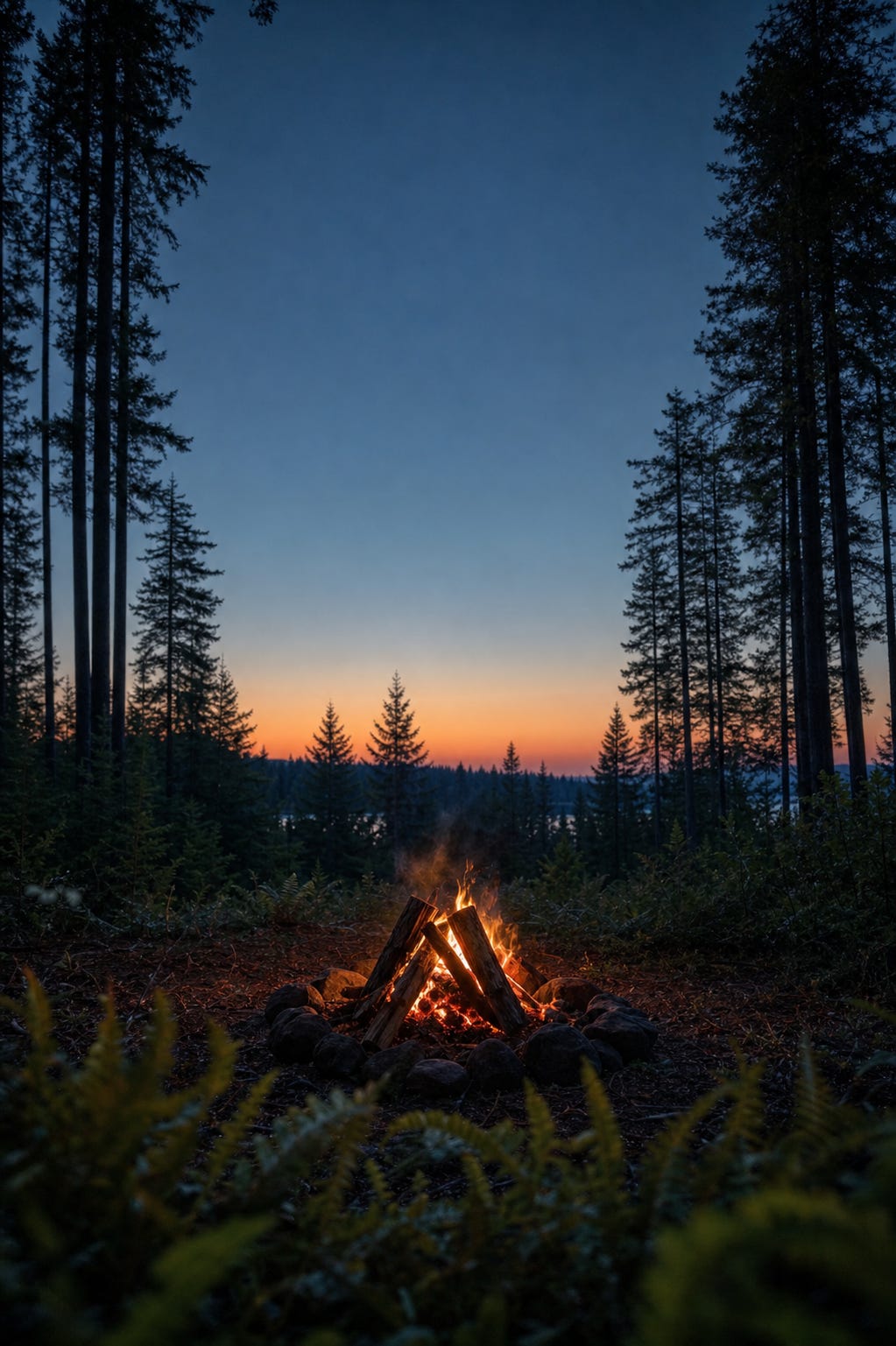
A man in his late forties is kneeling by a fire, surrounded by an attentive group of men, with the quiet presence of the forest as the backdrop. It is his turn to speak. He has been crying, quietly, for about a minute. Nobody has said anything. Nobody has moved to comfort him. There is no music, no ceremony, no script. He finally takes a breath and says the thing he came to say, which turns out to be smaller and stranger and more honest than what he had rehearsed in the car on the way over.
The men around him relax, almost imperceptibly, because some part of each of them recognizes that what was just said was true, and needed to be said. What follows is a round of practiced reflections — not unsolicited advice, but each man sharing what came up in him as he listened. It is a way of letting one man’s truth become a shared experience. A way of making the man feel seen, loved and accepted for who he is in that moment. A way of reminding him, without saying it directly, that he is not alone.
Something in his share has touched something deep in another man, and a self-facilitated inquiry into shame begins. The circle becomes a metabolic process — old thoughts and feelings, stuck for years, moving out into the open where they can be released, where space can be cleared in the psyche of every man present. When it is finished there is a discernible settling in the group, a brief pause, an energetic clearing of the space and then the next man begins to “check in”.
This is happening, right now, in church basements, living rooms and forest clearings, on Zoom at midnight and around fires that take an hour to build properly. It does not make headlines. There are no charismatic leaders, no viral videos, no platform to defend. Just men learning, often for the first time in their adult lives, how to feel something all the way through without trying to fix it, win it, or run from it.
This is what is sometimes called men’s work.
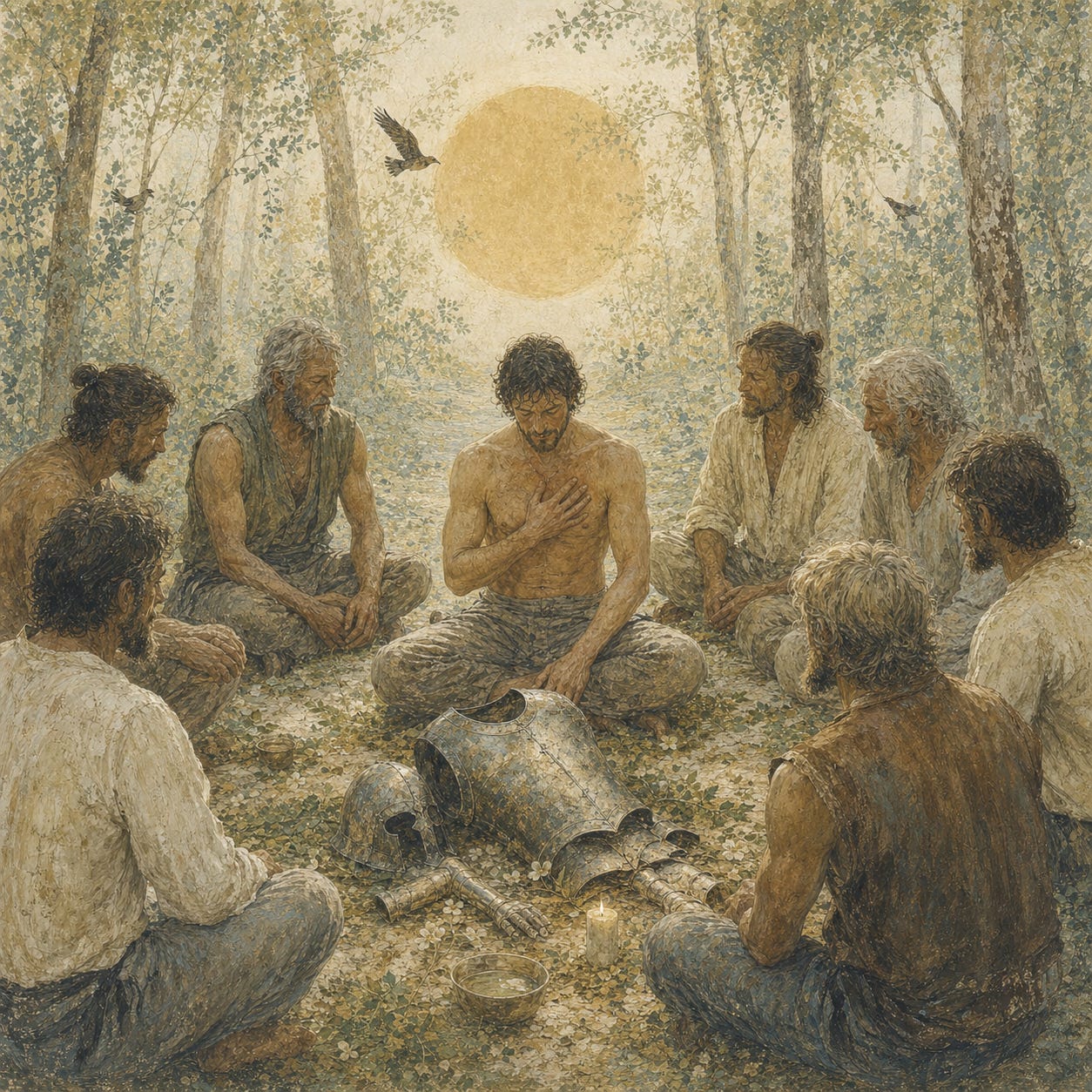
In my experience, for real men’s work to take root, a foundation has to be laid in the form of a rite of passage. A sojourn — physical, mental, emotional, spiritual — epic enough to break you down and intelligent enough to build you back up in relationship to yourself, other men, your family, your community, the land that nourishes you, and all that is both seen and unseen.
Over time, many of these rites have been kept secret, for good reason. The unknown is a powerful ally when it comes to igniting the spark of change; what cannot be anticipated cannot be performed. But the secrecy also does a disservice in these times. It keeps the foundation of men’s work hidden from the world, and so robs the work of its gravitas, its depth and shape… the crucible in which everything that follows is forged into something lasting, something capable of meeting the wounds men carry in a broken world.
In an age of endless novelty, where people have literally absorbed enough brands to last them several lifetimes, the phrase ‘men’s work’ is perhaps at times unfortunate. It suggests something that excludes, something earnest and self-serious, something adjacent to the “manosphere” or to the wellness-industrial complex. It can summon images of bare-chested men beating drums in the woods — an image that, in a culture allergic to ritual, is almost impossible to take seriously, or worse, easy to dismiss as ostentatious.
But the practice is much older than its caricatures, and practices that metabolize stuck emotions and unhealed habits are vital at such a time when the world is backed up with unfelt pain and anguish, ungrieved loss and fear of the unknown.
I want to write about it plainly — what it actually is, where it came from, what it has done for me and for the men, kids, families and communities I’ve worked with, and why the concept of men’s work is sometimes misunderstood, or misrepresented in the dominant culture. I’m presenting this article from a place of reverence, of experience, of deep exposure to the quiet revolution happening in the psyche of male-bodied people who are willing to turn towards the pain and be a compassionate witness. So this is an invitation to look more carefully at something that is easy to dismiss and harder to do.
Let me clear some ground.
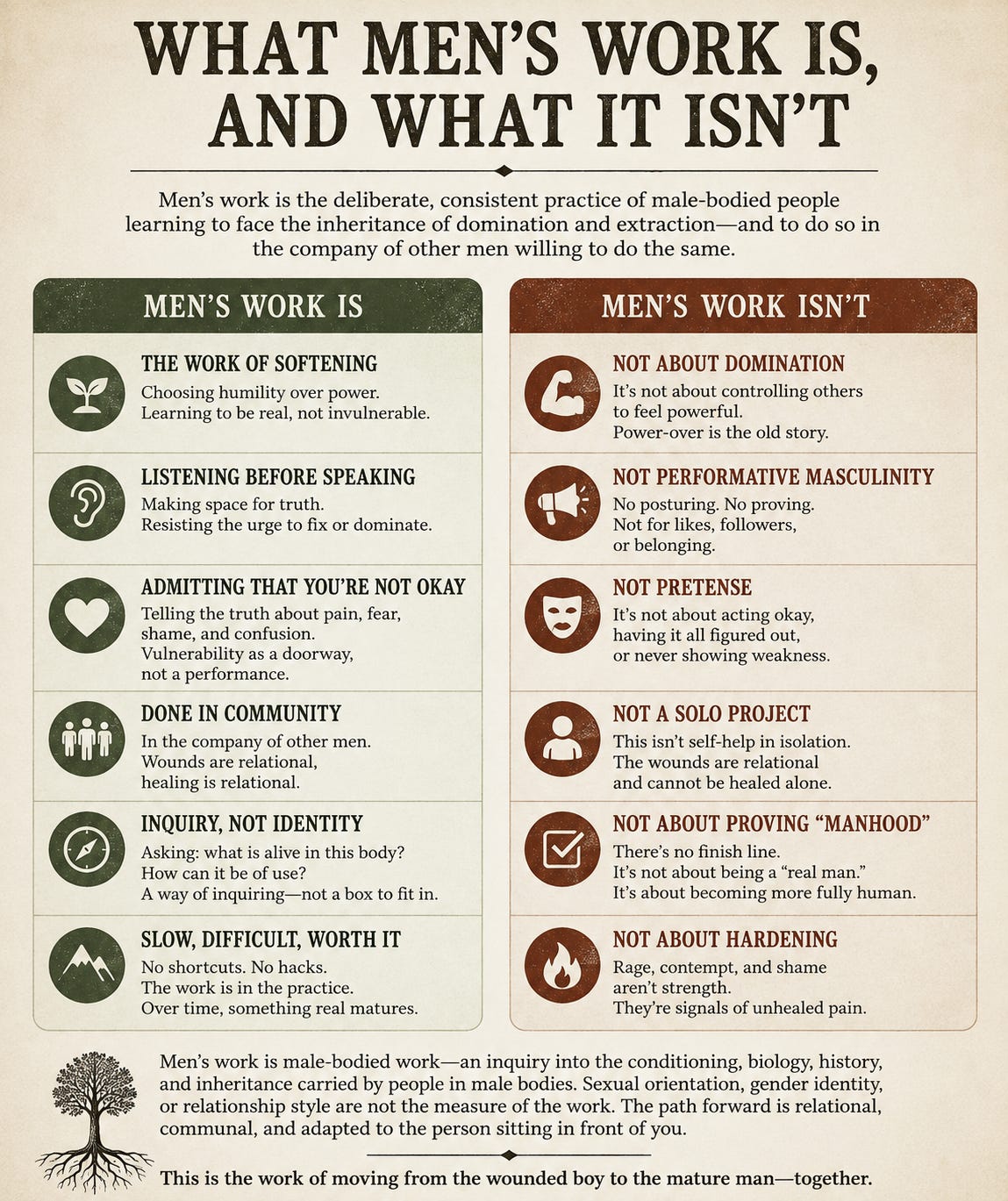
Men’s work, as I understand it and as it is practiced in the lineages I’ll describe below, is the deliberate, consistent, often slow, often difficult practice of a male-bodied person learning to face the inheritance of what it has meant to be biologically male in a culture shaped by thousands of years of domination and extraction — and to do so in the company of other male-bodied people willing to do the same. It is the work of softening, not hardening. Of humility, not power. Of listening, not speaking. Of admitting that one is not okay before learning to be okay in a way that is not pretense.
Which is why the algorithmic version of masculinity — the manosphere influencer telling you to dominate your way back to potency — is, despite its claim to the territory, almost the precise opposite of the work I’m describing. That version of masculinity sells the wound as the cure. The work I’m describing slowly metabolizes the wound. They are not the same project, and one of the small services this essay can perform is to refuse to let the louder version speak for the quieter one.
This is the work of moving from the wounded boy to the mature man — and it is undertaken in community precisely because the wounds are relational and cannot be healed alone.
Importantly — and I want to say this early because it sometimes gets confused — men’s work, properly practiced, is not gendered work in the narrow sense. It is male-bodied work: an inquiry into the conditioning, biology, history, and inheritance carried by people in male bodies. Whether the person doing the work is gay, straight, bi, trans, cis, polyamorous, monogamous, fluid, or any combination — in my experience over many years now, this is largely irrelevant to whether the work is real for them. These are basic human issues that arise from millennia of masculine dominance and that affect each of us in different ways. The path forward is relational, communal, and adapted to the person sitting in front of you. As Stephen Jenkinson, founder of the Orphan Wisdom School, has put it, gender itself may be best understood “as a way of inquiring rather than [a thing] to inquire about.”
Men’s work is not about proving anyone is a man. It’s about asking, in the company of others doing the same, what is alive in this particular body and how it might be of use for healing some very deep, systemic wounds in a highly displaced, traumatized culture.
A very short history of where this came from
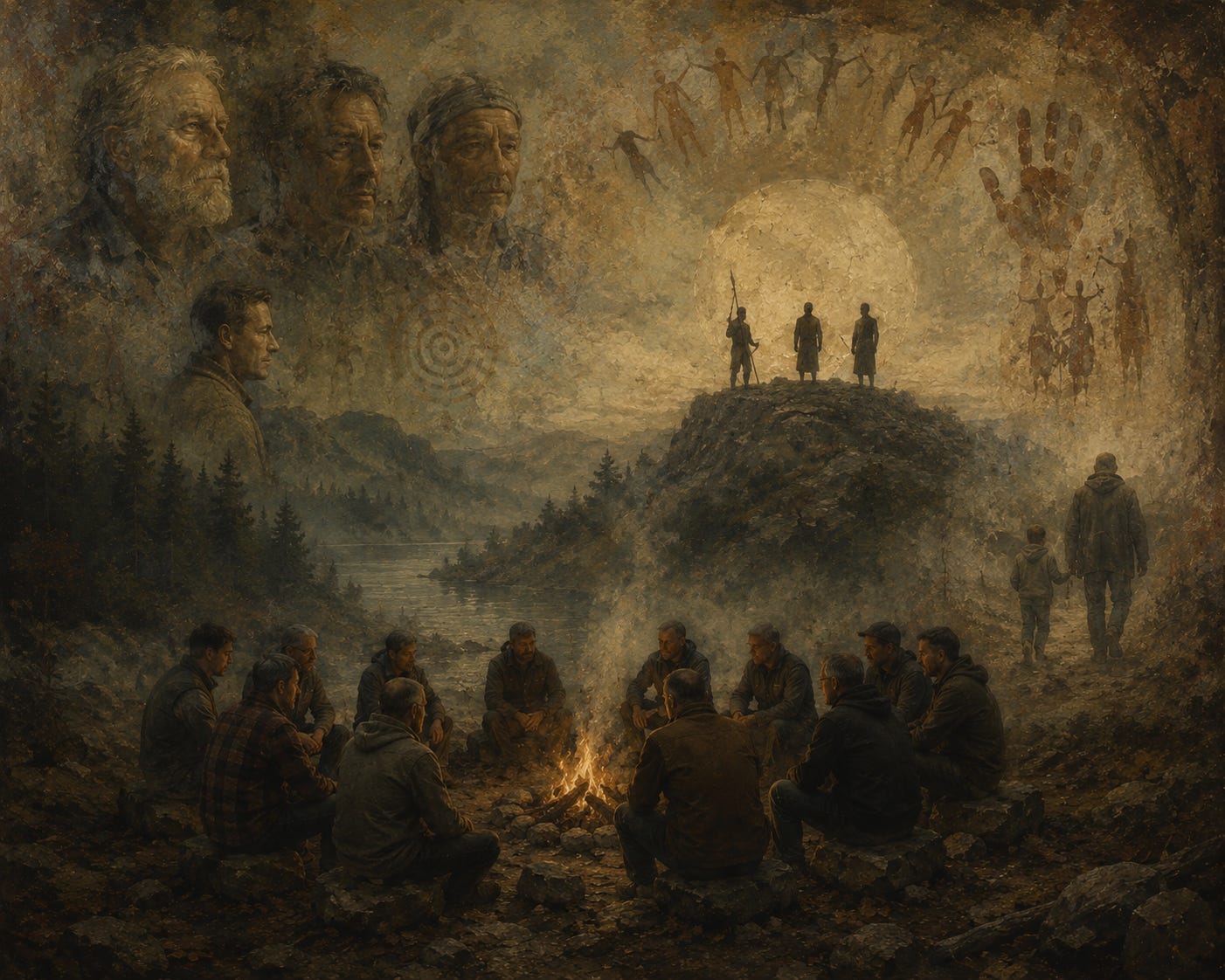
The contemporary men’s work movement has roots in two places: the mythopoetic men’s movement of the late 1980s and 1990s, and a much older anthropological reality — the cross-cultural practice of male initiation.
Robert Bly’s Iron John, a book-length meditation on a Brothers Grimm fairy tale, became the founding text of what came to be called the mythopoetic men’s movement. Bly, working with the Jungian psychologist James Hillman and the storyteller Michael Meade, ran annual gatherings — the Minnesota Men’s Conference — at which men sat together and worked with myth, poetry, music, ritual, and grief.
The conferences were built — as the Minnesota Men’s Conference’s founding announcement put it, and as Ian reflects on at length in his essay “Where the Wild Men Are” — around the recognition that “the souls of men were atrophying in a culture that was essentially in the process of colonizing its own people and of de-animating the living world. As an antidote to a culture of emptiness, of shallowness, and of disconnection from the web of being, men came together to work with mythic story, with images, with poetry. We placed ourselves into the mythic, into stories that contain traces of the old pathways to becoming a fully developed human being.“
The first wave — Bly, Hillman, Meade, the Jungian analysts Robert Moore and Douglas Gillette whose King, Warrior, Magician, Lover gave the movement its archetypal grammar — was visible, sometimes ridiculed, sometimes parodied, and after about a decade went largely underground. It continued the work in smaller circles, away from the spotlight, through the long quiet between the early 1990s and the cultural moment we are now in.
In parallel, in Wisconsin in the mid-1980s, three men — Bill Kauth, Rich Tosi, and Ron Hering — founded what would become The ManKind Project, the largest men’s training organization in the world. Their flagship training, the New Warrior Training Adventure, has now run in twelve countries for forty years. A decade later, the Boys to Men Mentoring Network was founded in San Diego to extend the work to teenage boys without sufficient male presence in their lives.
Much of what I know about this lineage I’ve learned firsthand, over years in rooms with men like Bill Kauth, Stephen Jenkinson, Martín Prechtel, and many others who have shaped me deeply. Much of what I’ve learned to see in it, though — the threads connecting elders to emerging voices, indigenous wisdom to mythopoetic practice, grief work to land work — I owe to the patient, generous work of the Canadian filmmaker and podcaster Ian MacKenzie, who has spent the last decade gathering this territory into one extended conversation on his Mythic Masculine podcast and through the School of Mythopoetics he co-founded. Ian is a dear friend, and one of the most thoughtful curators of this territory I know. Many of the voices that appear in this piece — Bayo Akomolafe, Taiaiake Alfred — I first encountered or returned to more deeply because of his work. The lineage stays alive because people sit in rooms with each other, and because people like Ian do the slow work of holding the threads together.
These are the institutional roots. The deeper roots — the anthropological ones — go back to almost every traditional human society we know about.
Rites of passage: the technology that almost every culture had
I learned the structure of rites of passage less from books than from living them, watching them, and helping to hold them. I have been trained as a mentor to boys, which is itself a rite of passage. I have been through the New Warrior Training, which is one. I have sat with hundreds of men who have come out the far side of theirs. I designed part of my own wedding as a rite of passage for my fiancée and me, and I have taken myself out alone, into the land, for solo grief rites that gave me back parts of my life I thought were gone.
But it was in the years I worked as a youth rites-of-passage facilitator with Boys to Men of Southern Oregon that I watched the same shape repeat itself across very different people. There is always a separation... the boy is taken from his ordinary life, his phone, his bedroom, the soundtrack he uses to keep his interior at bay. There is always a threshold time of difficulty and not-knowing — anthropologists call this liminality, from the Latin for threshold, but in the field you don’t need the word; you can see it on a fourteen-year-old’s face when he realizes nobody is going to rescue him from what he is feeling. And there is always a return, where the community confirms what has happened and gives the boy a place to put it.
These stages have been prevalent and visible in cultures across the world for as long as we have records of human life — the Maasai, the Lakota, the Jewish bar mitzvah, the Dagara of Burkina Faso whose traditions Malidoma Patrice Somé brought to Western audiences, and countless others. What I’ve seen in the field, watching boys come back together after a hard threshold, is something I’d just call real community — a deep, status-flattening bond between those who’ve passed through something together, more enduring than any ordinary social tie. Stephen Jenkinson calls it village-mindedness: the felt memory, in the body, of what village life used to be for our ancestors, and the grief of its absence in most of our lives now.
What rites of passage do, psychologically and socially, is several things at once. They take the volatile, dangerous energy of a young person — particularly a young male, who in most cultures has more raw aggressive and sexual energy than he knows what to do with — and they channel it. They give it form. They confer adult identity rather than leaving it to be self-claimed through risk-taking, violence, or consumption. They mark belonging. They pass on the moral and spiritual inheritance of the community. And they confirm that the young person is no longer alone in the world but is now responsible for it.
The argument made — by Bly, by Moore, by the modern men’s work teachers — is that industrial Western culture has lost this technology. We have schooling, which is education without initiation. We have age-of-majority legal thresholds, which are bureaucratic without being ceremonial. We have religious confirmations and bar mitzvahs in some communities. But for most boys in most of the West, there is no moment, no person, no community that says: the boy you were is over now. We see who you are becoming. We confirm it. We carry it with you.
When the initiation is missing, Malidoma Somé argued, the energy doesn’t disappear. It finds substitutes. Gangs. Fraternities. Combat sports. The military. Pornography. Substances. Figureheads and false heroes. The endless adolescence of the man who has never been told by an older man that he has what it takes — and who has therefore never been able to stop performing.
This is an argument I find largely persuasive, but I want to be careful with it. The diagnosis can become romantic — a longing for a lost ceremonial culture that, examined honestly, often included violence, exclusion, and rigidity that we are right not to want to restore. Some traditional initiations were brutal in ways that are not separable from the patriarchal cultures that practiced them. Modern men’s work isn’t a return to those forms. It’s an attempt to recover the function — the threshold, the elders, the witness, the recognition — in forms appropriate to who and where we now are.
A note on the contested past
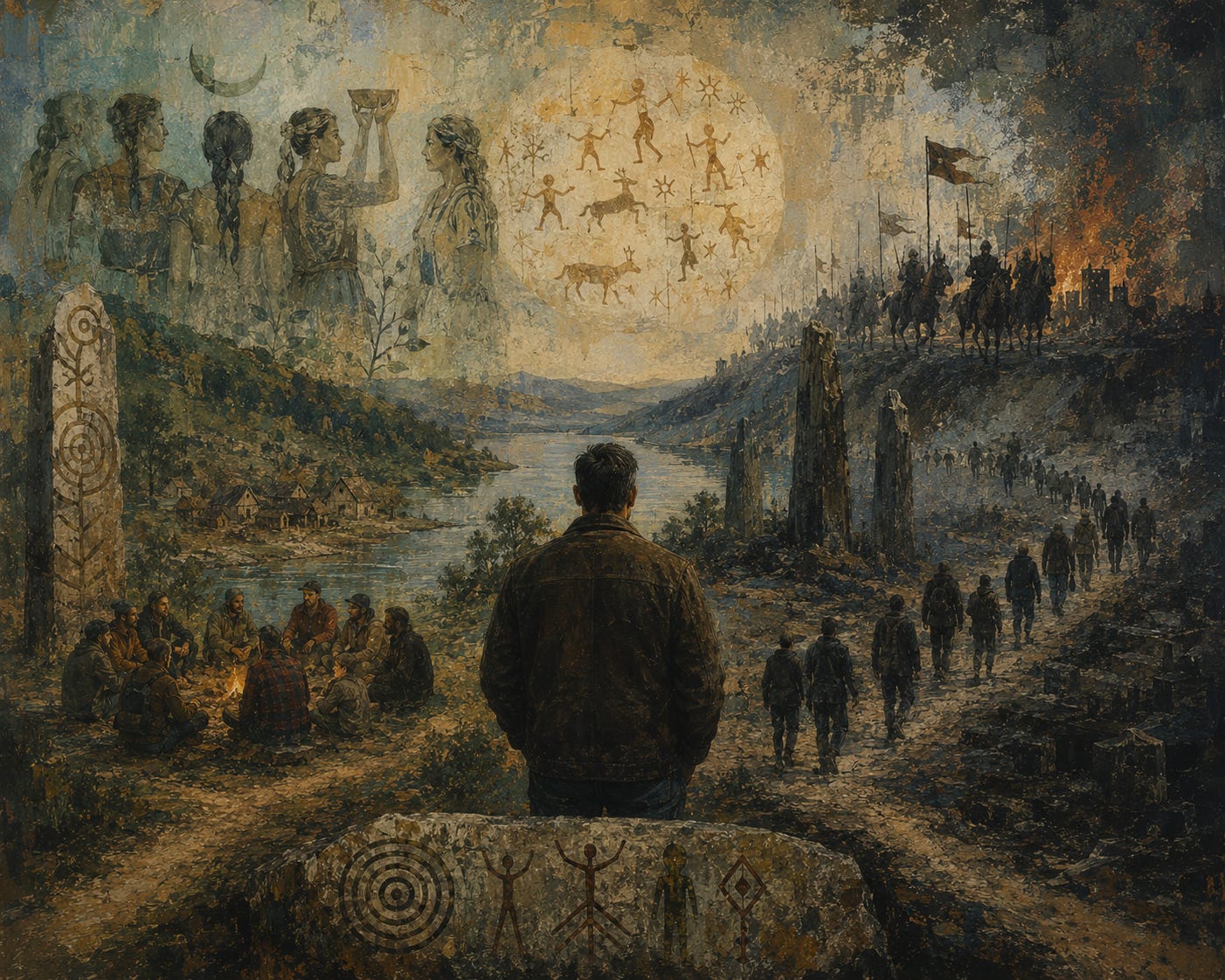
I want to pause here, because something I’ve written about elsewhere on this Substack is worth holding honestly.
Marija Gimbutas’s Old Europe thesis — that from roughly 7000 to 3500 BCE, large parts of Southeastern Europe were organized around goddess-centered, matrilineal, relatively egalitarian, relatively peaceful societies that were eventually overrun by patrilineal Indo-European pastoralists — is partly vindicated and partly contested. Her Kurgan migration thesis is now strongly supported by genetic evidence. Her characterization of what was displaced — peaceful, egalitarian, goddess-worshipping — is more contested. Mainstream archaeology has questioned the move from “many female figurines” to “matriarchal theocracy” as an interpretive overreach.
The honest version is this: the archaeological and ethnographic record demonstrates that humans have organized themselves in many more ways than the story of patriarchal domination suggests. Living matrilineal societies — the Mosuo of Yunnan, the Minangkabau of Indonesia, the Khasi of northeast India, the historic Iroquois Confederacy — demonstrate that partnership-oriented organization is not utopian fantasy but documented human reality. Recent archaeological work has been broadening the picture further: human societies appear to have been radically more diverse, in their forms of organization and authority, than the standard story of linear progress-from-savagery suggests.
What we can say honestly: the dominator model is not the inevitable expression of human nature. It is one expression among many. The men’s work I’m writing about is, in part, an attempt to recover the relational intelligence that other human cultures have at various times kept alive — without claiming we ever lived in paradise.
The inheritance
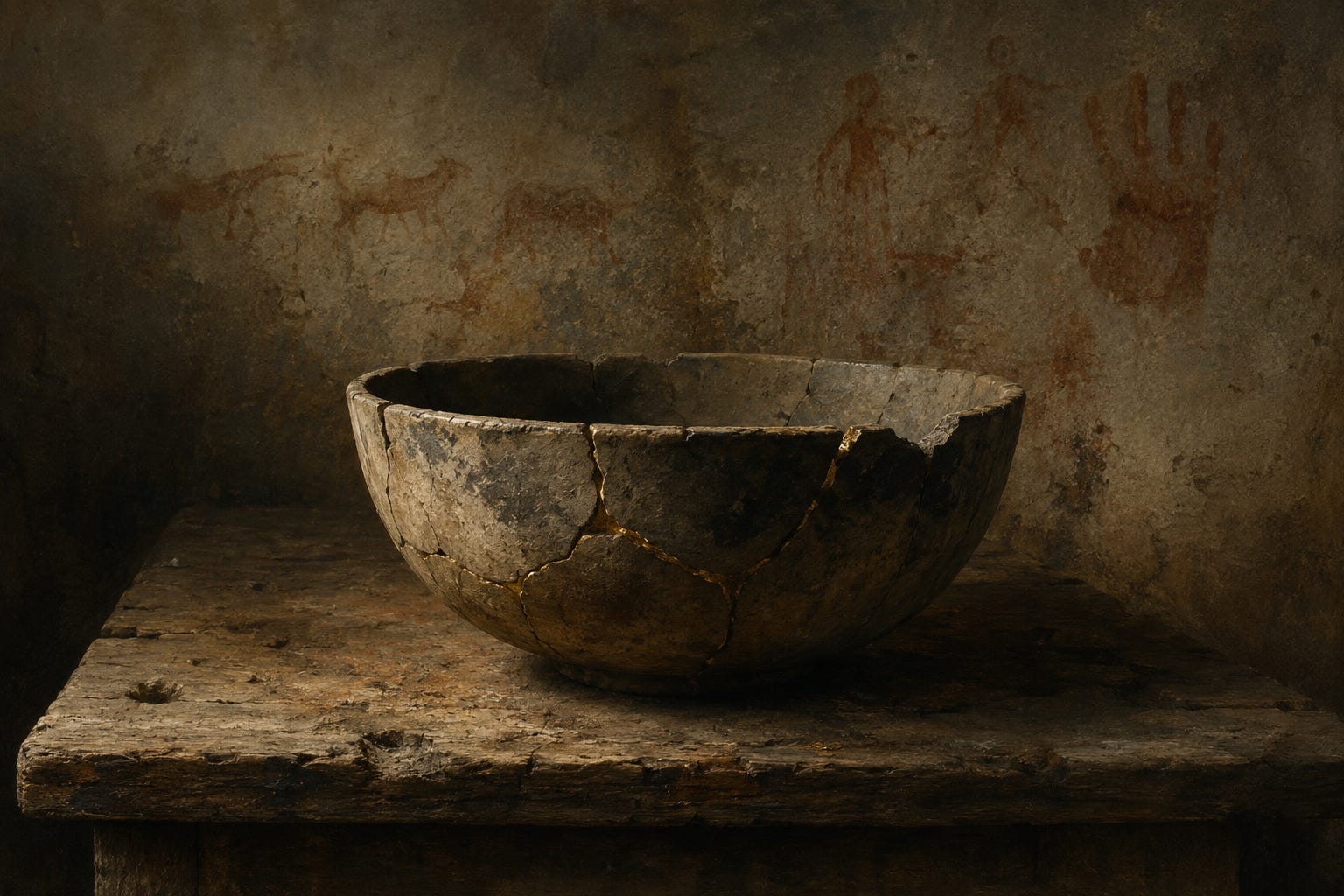
To do this work well requires an honest inventory of what we’ve inherited.
What is sometimes called the patriarchal pattern — what I call the scarcity wound — is a way of being in the world that emerged around six thousand years ago, at a scale we don’t fully understand. Some scholars locate its origins in a massive climate shift across Eurasia: colder winters, drying grasslands, contracting access to water. In the cultures that followed, the capacity to hoard, dominate, extract, and control became the central organizing principle of complex societies. The author Michael Easter has described the behavioral signature this leaves in the modern nervous system as the scarcity loop — opportunity, unpredictable reward, quick repeatability — the pattern that turns hunger into compulsion. The wound is the inheritance; the loop is the behavior the inheritance compels.
The hardest thing about being inside this pattern is that we cannot easily tell whether our solutions are coming from the wound itself. The man who fixes problems by being louder, more dominant, more in control is reproducing the pattern. The man who fixes problems by collapsing, abdicating, refusing responsibility is also reproducing it — Moore and Gillette called these two the Tyrant and the Weakling, and they noted that underneath every blustering Tyrant is a scared Weakling, and underneath every cowering Weakling is a Tyrant waiting to explode. They are not opposites. They are the same wound expressed at two ends of one collapsed spectrum.
This is why the work cannot be solitary, and why it cannot be intellectual. You cannot think your way out of a pattern that thinks for you. You need a container, you need other bodies, you need someone you trust who can mirror back to you what you can’t yet see, and you need enough time and enough difficulty for your usual moves to fail.
What a circle of men can do
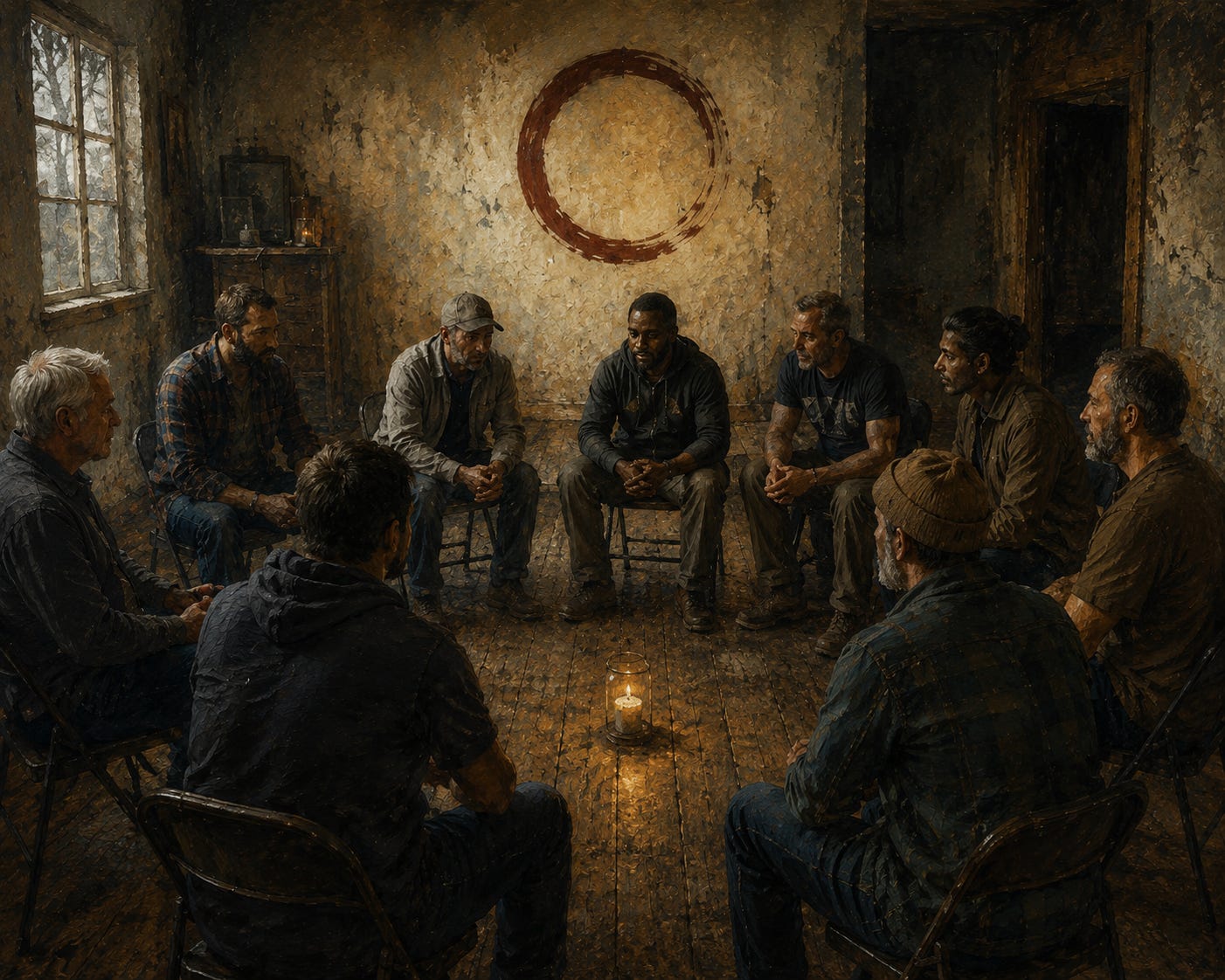
I came into this work as an accident of circumstance.
In my mid-thirties, I became a step-father to a young boy whose biological father had left his mother before he was born — re-enacting, as I would only later understand, an old pre-natal abandonment wound that was itself part of a longer story I won’t tell here, because parts of it are not mine to tell. The boy responded to me, and to his mother, with the full repertoire a child develops when he has not been securely held — distance, selective hearing, defiance, a kind of psychic deafness that turned almost any request into a battle.
I had no idea what to do with him. Or rather, I had only one idea, and it was the one that had been done to me. I was raised in Newfoundland as a small child, after my parents moved us from England — a transplant into Canada’s poorest province, with one of the most poorly developed school systems in the country. The only thing I knew how to do with such a child was what had been done to me there: insist, intimidate, threaten, be bigger, be louder, insist, punish, occasionally reward. None of it worked. What it produced in me, surprisingly, was a sense of powerlessness and a heat of rage I had not known I was carrying.
We moved, on a friend’s advice, to Ashland, Oregon — which I would later learn was something of a quiet hub of the ManKind Project, with Bill Kauth himself living in town and many hundreds of men in the surrounding region having passed through the New Warrior Training. I did not know any of this when we arrived. What I knew was that we put my step-son in a Waldorf school whose liberal philosophy turned out to leave the social pecking order unsupervised; that he was bullied; that the situation at home was getting worse, not better; and that I needed help.
I found it in a place called Boys to Men of Southern Oregon, a local organization in the lineage of the ManKind Project, where a small group of men gathered weekly with boys to play games, sit in circle, run a check-in, tell honestly the highs and lows of the week, and demonstrate, simply by being there, a way of being a man that I had not seen before. Beyond the weekly circles, the humble volunteer organization also ran weekend rites of passage adventures for boys aged seven to eighteen — and it was there, in the field, that I first encountered this timeless process of initiation, profoundly safe and deeply nourishing to the soul.
I had been raised by a father who was an anomaly in Newfoundland — a kind, non-authoritarian, Quaker-educated man whose own grandparents had founded a school in England in the early twentieth century, when European educators were experimenting with what they called “power-with” rather than “power-over” pedagogy. My father had given me what he could of that. But every other authority figure in my childhood — the teachers who used the cane, the headmasters who used suspension, the bullies who used fists — had taught the opposite lesson. And under the daily pressure of a child whose nervous system was set to fight everything, those older lessons were the ones that kept rising up in me. I knew, intellectually, that domination would not heal what was broken between us. I felt the pull toward it anyway. That contradiction was alive in me when I walked into that Boys to Men room. There were men, with boys, who were curious instead of reactive. Empathic instead of punitive. Honest about how they felt without blaming or shaming. Capable of holding boundaries without violence and of holding warmth without collapse. The boys responded to them with respect built from trust.
And I felt, in my body, an old objection rise up. Why should I give to my step-son what wasn’t given to me? Why should he get kindness when he’s being a pain in the ass?
That objection, examined honestly, is the engine of the whole intergenerational pattern. It is the sound of a wound trying to reproduce itself.
Sitting with those boys, week after week, I began to recognize the boy in me who had never been sat with that way. The work I thought I was doing for my step-son turned out to be the work of meeting my own wounded boy — and meeting him in the company of men who could hold what no one had held for him.
I trained as a youth rites-of-passage facilitator — a training that turned out to be a rite of passage itself. It walked us back through the power dynamics of our own boyhoods, stripped away the identities we had built to survive them, asked us to be seen, fully, by a group of men we had no reason yet to trust, and then named us anew on the other side. Its particular focus, distinct from the New Warrior Training I would later go through, was the harm a man can pass on to a child when his own wounds have not yet been metabolized in the company of others. You cannot pass on what you have not yet faced. The training was a chance to face it.
I went, on the sponsorship of the men in that Oregon community, through the ManKind Project’s New Warrior Training Adventure. I won’t describe what happens at the end of that training; it needs to remain a surprise for the men who go. What I can say is that when I went through, I was joining a lineage of around forty thousand men who had walked through the same door before me. That number is now closer to seventy-five thousand, across twelve countries. I learned this fact later. What I felt, in my body, in the room where it happened — barely slept, exhausted, undone — was the weight of every one of those men as a force of good in the world. Not a metaphor. A force. Men I would never meet, would never know by name, who had each, somewhere, sat through their own undoing and come out the other side. I have not been the same since.
I felt the care of the men who taught me to stay curious in the presence of wounded youth. The care of the men who built the containers and held the boundaries through both trainings. The care of the men who ritually reflected my gold back to me in the mentorship work, and of the men who came from across the region to celebrate the final day of the New Warrior Training. The care of the men who received me when I returned from each threshold and named me — first as a mentor, then as a man — coming back home. None of this was performative. It was simple. It was — I want to use the word carefully — real.
From there I went deeper. I worked for years as a mentor to young men who had no father, or an absent or addicted or unavailable one. Through Boys to Men I joined a project with the Oregon Department of Justice, where after six months of cognitive-behavioral therapy and a restorative-justice process, incarcerated youth would be brought into a final mentorship session with us. We would walk into a room having never met the kid, get curious about him — what happened, what he learned, and most importantly what his gifts were, what his gold was — and reflect that gold back to him after enough trust had been built that he could hear it. Where possible, the final step was to bring his parents into the room and reflect what we had seen.
Those moments were potent and often heartbreaking. We would witness the hopeless circumstance many of these kids were entering back into — parents who had been told their kid was the problem, when often the family system and the carceral system were what was producing the “behavior problem” in the first place. When you look at the privatized penal system, the profit incentives in incarceration, the way the entire pipeline functions as a kind of manufactured slavery dressed up as justice, you start to see how much of this work is upstream of catastrophe. One man’s presence in the life of one boy at the right moment can be the difference between a life sentence and a life.
This is not romantic. It’s the actual mechanism by which the pattern is interrupted, one relationship at a time.
Power-with vs. power-over
The single most important thing I learned in the Oregon men’s circles, and through the New Warrior Training, and through every facilitator and mentor I have worked with since, is the distinction between power-over and power-with.
Power-over is the model most of us were raised inside. It assumes resources are scarce, that someone must be on top, and that authority is sustained by the credible threat of consequence. It works in the short term. It produces compliance. It also produces, reliably, a child who learns to comply outwardly while developing private worlds of resentment and concealed rage that will eventually find their expression somewhere.
Power-with assumes the opposite. It assumes that authority is sustained by trust, that trust is built by consistency and curiosity, and that the goal is not compliance but cooperation. The hardest thing about practicing power-with is that, for those of us conditioned in power-over, it feels at first like weakness. It feels like letting them get away with it. It is not. It requires more strength, not less, because the strength is the inner kind — the capacity to stay regulated when a child or a partner or a colleague is doing everything they can to drag you back into the old pattern. Power-with requires you to hold a boundary without weaponizing it. To be firm without being cruel. To be warm without being permissive. The Buddhist teacher Pema Chödrön and the Jungian James Hollis are pointing at the same capacity from different traditions: the ability to sit with discomfort without acting it out.
This is one of the core trainings of any decent men’s circle. You are repeatedly asked to feel something difficult and not do anything with it except notice it, name it, and let other men witness it. After enough repetitions of this, your nervous system begins to learn that you can survive feelings you previously would have offloaded — onto a partner, onto a child, onto a friend, onto the road, onto the bottle, onto the screen.
That is, very simply, what men’s work does.
Most of the lineages I’ll describe share a working map of the inner territory — the four archetypal energies Moore and Gillette named the Sovereign, Warrior, Magician, and Lover, each with a light expression and shadow expressions when it falls out of integration. The map matters because it gives the work a vocabulary. Instead of “something is wrong with me,” a man can ask: which energy am I in shadow with right now? Where did the door close? Who can I sit with while I learn to open it again? For readers who want the longer treatment, I’ve put it in the appendix.
Why this is “male-bodied” work, not gendered work
I want to come back to the question of who men’s work is for, because it gets misunderstood often, and because the misunderstanding is part of how the work gets dismissed.
Men’s work is not for “real men.” It is not a defense of biological essentialism. It is not a project to police the boundaries of masculinity against people who don’t conform.
It is, simply, a relational practice for people in male bodies — people who have, by accident of biology and culture, inherited a particular set of patterns, expectations, traumas, and gifts that come with being read as male in a patriarchal culture. The work of metabolizing that inheritance is not the same work as metabolizing the inheritance of being read as female, or being read as ambiguous, or living in the liminal space of transition. It is a particular medicine for a particular shape of wound.
A note worth saying directly. The inheritance of male dominance has cost female-bodied people in ways this article cannot hope to express — partly because I am male-bodied and would be speaking past my own knowing, and partly because that is an entirely different piece of writing, owed to and best written by women. What I am describing here is one half of a reckoning. The other half is happening elsewhere, often times in rooms I do not sit in. What I know of it I have learned from my grandmothers, my mother, my sisters, the women I have loved, and many teachers along the way... for which I am forever grateful.
In the circles I have been in, this has included gay men, trans men, bisexual men, men questioning their gender, men in long-term hetero marriages, single fathers, widowers, men in their twenties and men in their seventies. What we have in common is not who we sleep with, who we love, or how we express our gender. It is that we are each, in our way, in relationship with the inheritance of the male body in a culture that has not known how to hold it well.
I once watched a teenage, male-bodied, gender-fluid young person speak to a group of freshly trained adult mentors about his own revelations and reflections on what it means to live as gender-fluid in a body and a world that keep asking him to pick. It was some of the deepest imparting of wisdom I have ever witnessed in a room of male-bodied mentors... and it shaped us.
This is also why the work is both particular and universal. The wounds are particular to bodies; the path of healing — listening, witness, ritual, grief, accountability, community — is universal. The men’s circle and the women’s circle and the queer circle and the elder circle are all rooms in the same house. A house with many rooms is not less of a house than one with only one room.
Grief literacy, and the part that isn’t only about men

The deeper one goes into men’s work the sooner one arrives at grief.
This is not incidental. The teachers in this lineage — Stephen Jenkinson at the Orphan Wisdom School, Francis Weller with his Five Gates of Grief, Martín Prechtel teaching at Bolad’s Kitchen that grief and praise are the same word in Tzutujil Maya — converge on the recognition that modern Western culture is, in Jenkinson’s phrase, “death-phobic and grief-illiterate.” We do not know how to grieve. We do not know what to do with sorrow. We export it, medicate it, busy ourselves around it. And the cost of this is enormous — in addiction, in violence, in the strange, drifting, untethered quality of contemporary life.
I want to say plainly that this is not primarily a men’s issue. I have known many women who do not know how to grieve and are afraid of death. The grief illiteracy is cultural, not gendered. It is one of the things our particular form of civilization has lost.
But it is in men’s work — what we sometimes call I-groups, or integration groups — that the door first opened, for me, into territory I had not been raised to enter.
My own grief work has been deeply accelerated by my time in these rooms. I have wept with men over losses they had been holding back for decades, and I have touched my own sorrows in ways that have given me back what felt like years of my own life. The pillars of this work — the circles, the brothers, the held container, the accumulated trust — have allowed me to fall apart completely and decompose into a lighter, more loving version of myself, more capable of serving the world.
And I continue to grieve. I grieve the countless families trapped in what feels to me like an insane isolation — separated from the practical, communal wisdom that could so easily save them from generations of long-term family pain, mental illness, and the toxic stagnancy we see especially here in the United States, where school shootings have become the norm, where the resurgence of misogyny is a trending content category, where so many of our male leaders are consumed by war and control as the narrowest and most unholy expression of masculine power.
This is the weight that, in a circle of men who have learned how to grieve, becomes bearable. Not solved. Not optimized. Not fixed. Bearable — because it is shared, and because something in the body learns, finally, that sorrow is not the end of you.
The reason I think the work is more important than ever right now is that we are in a cultural moment of accelerating crisis — political, ecological, technological, relational — in which an enormous amount of unmetabolized grief is being acted out as rage, as conspiracy, as cruelty, as nihilism. The most valuable thing a circle of men can do for the world right now is build, in themselves and in each other, the metabolic capacity to feel the times we are in without flinching, blaming, or fixing. To grieve well. To love what is dying. To stay.
What it changes
If this all sounds quiet and inward, that is because it is.
But the effects, in my experience, are not.
The men I know who have done this work — over years, not weekends — are different to be around. They are not louder. They are not more impressive. They are not famous. What they are is more present. They take up less defensive space. They do not need to win the conversation. They listen with their whole body. They can be wrong without collapsing. They hold authority lightly when they have it and accountability cleanly when they have failed. They are unusually good fathers, unusually good husbands, unusually good colleagues, unusually good neighbors. Their kids are okay. Their marriages survive things that destroy other marriages. Their friendships go deeper.
This is, in aggregate, what changes a culture. Not headlines. Not movements. A long, quiet accumulation of men, embedded in families and workplaces and neighborhoods, doing the patient, sometimes agonizing work of not passing on what was passed to them.
The Mohawk scholar Taiaiake Alfred has said on Ian’s podcast that there is no good man without the health of the land. I agree, and I want to add the corollary: there is no health of the land without the health of the men who walk on it. The two are not separable. The work I am describing, done well, is also ecological work, also political work, also relational work. Because it is, finally, the same work.
A closing word, and an invitation
I’m going to end without arguing.
If you are a man and you have read this far, you probably already know whether something in you is being summoned. There are circles in nearly every city in the English-speaking world. There are weekend trainings — the ManKind Project, the Sacred Sons convergences, the Illuman gatherings, Boys to Men for those drawn to mentor. There are wilderness-based programs — Bill Plotkin’s Animas Valley Institute, the School of Lost Borders. And there is Ian — whose Mythic Masculine podcast remains the single best doorway into many of the lineages I’ve named here. I’m hoping to follow this piece with a longer conversation with him on the questions this article only sketches; that’s for the next post.
If you are not a man and you have read this far — thank you. The work I am describing is, at root, in service of the people in your lives. It does not require your permission, but it benefits enormously from your patience while it happens, especially in its early, awkward stages. The men who are doing it well are very often unrecognizable as men doing important work, because the work is, by its nature, quiet.
We are not looking for new heroes. We are looking for a forest of differently-shaped men, each rooted in their particular place. We are looking, as I have written before, for each other.
The fire is in many places these days. Something old is also growing back.
***
With thanks to the men of Boys to Men of Southern Oregon, the brothers from the New Warrior Training, the boys I have had the honor of mentoring, and the writers and teachers cited here whose work has made my own life navigable.
Appendix: The four archetypes
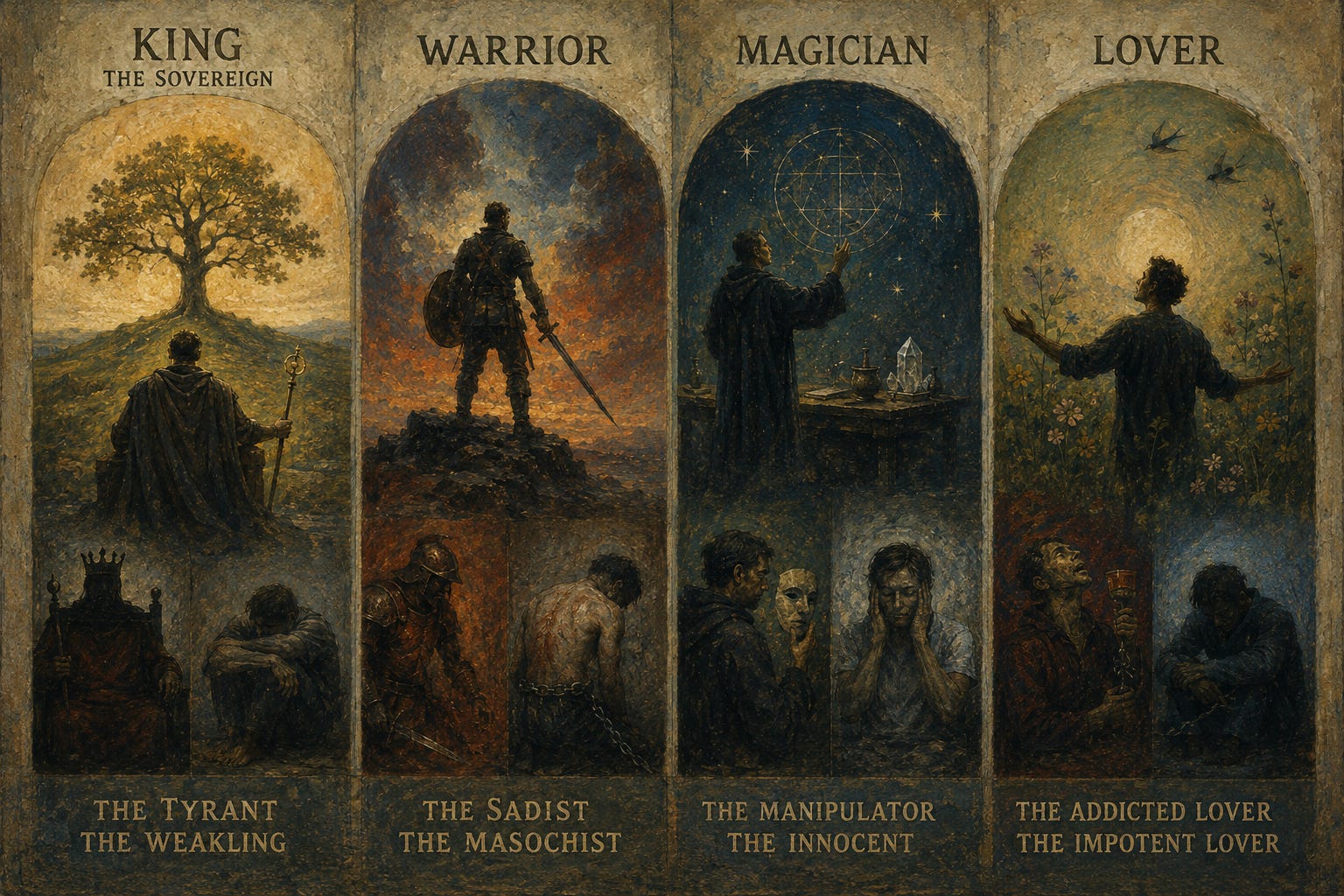
For readers who want the longer version of the map.
Moore and Gillette’s King, Warrior, Magician, Lover identifies four archetypal energies, each with a light expression (when integrated and serving the whole) and two shadow expressions — one “active” (dominance, aggression) and one “passive” (collapse, abdication). Moore noted that the two shadows tend to work in tandem: underneath every blustering Tyrant is a scared Weakling, and underneath every cowering Weakling is a Tyrant waiting to explode. They are not opposites. They are the same wound at two ends of a collapsed spectrum.
The Sovereign, or King. The energy of just and generative ordering. Not the energy of ruling but of creating the conditions under which everything else can flourish. The full Sovereign blesses, affirms, and orients toward the welfare of the whole. He holds the other archetypes in their proper place. In the absence of the King, Moore and Gillette write, the Warrior becomes a mercenary, the Magician becomes a sophist (able to argue any position and believing in none), and the Lover becomes an addict. The shadows: the Tyrant (King energy that believes the kingdom exists for him) and the Weakling (King energy abdicated, the man who refuses to be responsible for his own life).
The Warrior. Disciplined, purposeful, nonviolent aggression in service of a transpersonal cause. Decisive action, total commitment, the capacity to act in the presence of suffering when the cause demands it. The positive Warrior energy destroys only what needs to be destroyed in order for something new and fresh, more alive and more virtuous to appear. The shadows: the Sadist (Warrior energy turned to cruelty for its own sake) and the Masochist (the collapse of the Warrior into self-victimization).
The Magician. The energy of initiation, transformation, knowledge, and discernment. The shaman, the teacher, the therapist, the technician of the sacred. The Magician archetype in a man is his “bullshit detector”; it sees through denial and exercises discernment. The shadows: the Manipulator (knowledge as weapon, withheld for leverage or status) and the Innocent (the willful refusal to know — playing dumb to avoid responsibility).
The Lover. The capacity to be fully present, to be moved, to be in relationship with the world. Sensory aliveness, emotional availability, mystical awareness of the underlying connectedness of things. The Lover is the patron of art, music, beauty, mysticism, embodied experience. The shadows: the Addicted Lover (the compulsive seeker of the next high, always searching for something just over the next hill) and the Impotent Lover (numbness, disconnection, inability to feel).
A note worth saying carefully: Moore and Gillette framed these as mature masculine archetypes. The contemporary practice, including in many of the lineages most influenced by their work, has come to understand them as human capacities — patterns available to anyone, conditioned differently by gender but not gendered in their essence. A woman can sovereign a kingdom. A non-binary person can wield a clean Warrior energy. A gay man can move in the Lover archetype with full presence. The map is useful precisely because it is not biology. It is a description of energies the soul reaches toward when it is well-nourished, and falls into shadow when it is not.
Resource library
A working bibliography of teachers, writers, and organizations doing this work. Inclusion is not endorsement of every word — these are doors, not doctrines.
Recommended Podcast — The ManKind Podcast: “What Happens When Men Don’t Have Village” with Ian MacKenzie — a 2026 conversation between Boysen Hodgson of the ManKind Project and Ian MacKenzie, covering much of the territory of this article: the mythopoetic roots, the loss of village, the difference between this work and the manosphere, and why grief and ritual matter now.
Recommended Gathering — Cascadia Men's Conference, August 6–9, 2026, Squamish Valley, BC — a new mythopoetic gathering in the Pacific Northwest, in service to "tending culture through spirit, soul, and embodiment," with teachers from the Minnesota Men's Conference lineage among others.
Founding voices of the mythopoetic era —
Robert Bly (Iron John);
Robert Moore & Douglas Gillette (King, Warrior, Magician, Lover);
Michael Meade (Mosaic Voices, the Living Myth podcast);
Sam Keen (Fire in the Belly);
James Hillman (archetypal psychology).
Grief, ritual & indigenous wisdom —
Francis Weller (The Wild Edge of Sorrow, the Five Gates of Grief);
Martín Prechtel (The Smell of Rain on Dust; teacher at Bolad’s Kitchen);
Stephen Jenkinson (Die Wise; Orphan Wisdom School);
Malidoma Patrice Somé (Of Water and the Spirit); Sobonfu Somé.
Jungian, depth & trauma —
James Hollis (Under Saturn’s Shadow);
Bert Hellinger (Family Constellations);
Gabor Maté (In the Realm of Hungry Ghosts; The Myth of Normal);
Dan Siegel (interpersonal neurobiology).
Embodied & relational —
Terry Real (Relational Life Therapy);
Bill Plotkin (Soulcraft; Animas Valley Institute);
Justin Baldoni (Man Enough — popular gateway).
Decolonial and adjacent —
Bayo Akomolafe (the Emergence Network);
Charles Eisenstein (Sacred Economics);
Sophie Strand (The Flowering Wand; rhizomatic, mycelial visions of alternative masculinities);
Taiaiake Alfred (Wasáse);
Riane Eisler (The Chalice and the Blade).
Contemporary voices —
Ian MacKenzie (The Mythic Masculine podcast; School of Mythopoetics);
Bill Kauth (A Circle of Men);
Boysen Hodgson (MKP USA);
Eivind Skjellum (Reclaim Our Inner Throne);
Matt Sturm (The Organic Masculine);
Sacred Sons;
Trans and non-binary perspectives within men’s work —
Zhenevere Sophia Dao (MogaDao Institute; post-Daoist gender theory);
Kai Cheng Thom (I Hope We Choose Love);
Emmanuel H. Brown and others, featured in the Mythic Masculine’s “Trans Men: In Their Own Words” series.
Organizations —
The ManKind Project / New Warrior Training Adventure (mankindproject.org);
Boys to Men Mentoring Network (boystomenusa.org);
Illuman (illuman.org, Christian-rooted, in lineage of Richard Rohr);
Animas Valley Institute (animas.org);
School of Lost Borders (schooloflostborders.org);
Orphan Wisdom School (orphanwisdom.com);
The School of Mythopoetics.
Thank you for your article. It moved me deeply and spoke straight from my heart. The men in my men’s circle are also resonating with it very strongly.
It has also unlocked something in me — a holding back, a resistance to finally becoming more active in men’s work myself, and to begin writing, perhaps podcasting, and creating and holding my own offerings for men. Thank you for that.
I live in Germany, and unfortunately things here feel somewhat similar to what you describe over there — at least that is how I perceive it. Men’s work is still almost completely under the radar here, and the little bit that does get picked up by mainstream media tends to focus only on the regressive currents, which in Germany are unfortunately strongly connected to a political shift to the right. We don’t have a Trump as chancellor yet, but the right wing is clearly on the rise.
At the same time, there is also MKP in Germany, as well as other strands of men’s work of the kind you describe. I feel a very strong call within me to help bring more of this to Germany — and perhaps to develop a voice for it.
I resonate deeply with the people and organizations you mentioned. I have followed Ian MacKenzie for a long time, John Wineland’s book From the Core was very important for me, David Deida of course, and I am deeply grateful to have attended an NWTA with MKP three years ago.One person I would definitely add to your list is Matt Sturm and his work.
And a special thank you for your perspective on how we can distinguish men’s work — as male-bodied men’s work — and why that distinction matters. I find that very fitting and valuable. It speaks directly to a question I am often confronted with as well: why we separate men and women instead of immediately bringing them together, or why we don’t simply dissolve gender altogether…
I sent this to my husband John as it is filled with teachers, therapist and scholars that I have read (and some new referrals as well). I didn't know about the Podcasts, but will check it out. Thanks...Victoria