
Staying Informed Is Not the Same as Staying Regulated
Notes from the Sacred Valley on doomscrolling, dysregulation, and the quiet work of being useful in times like these.

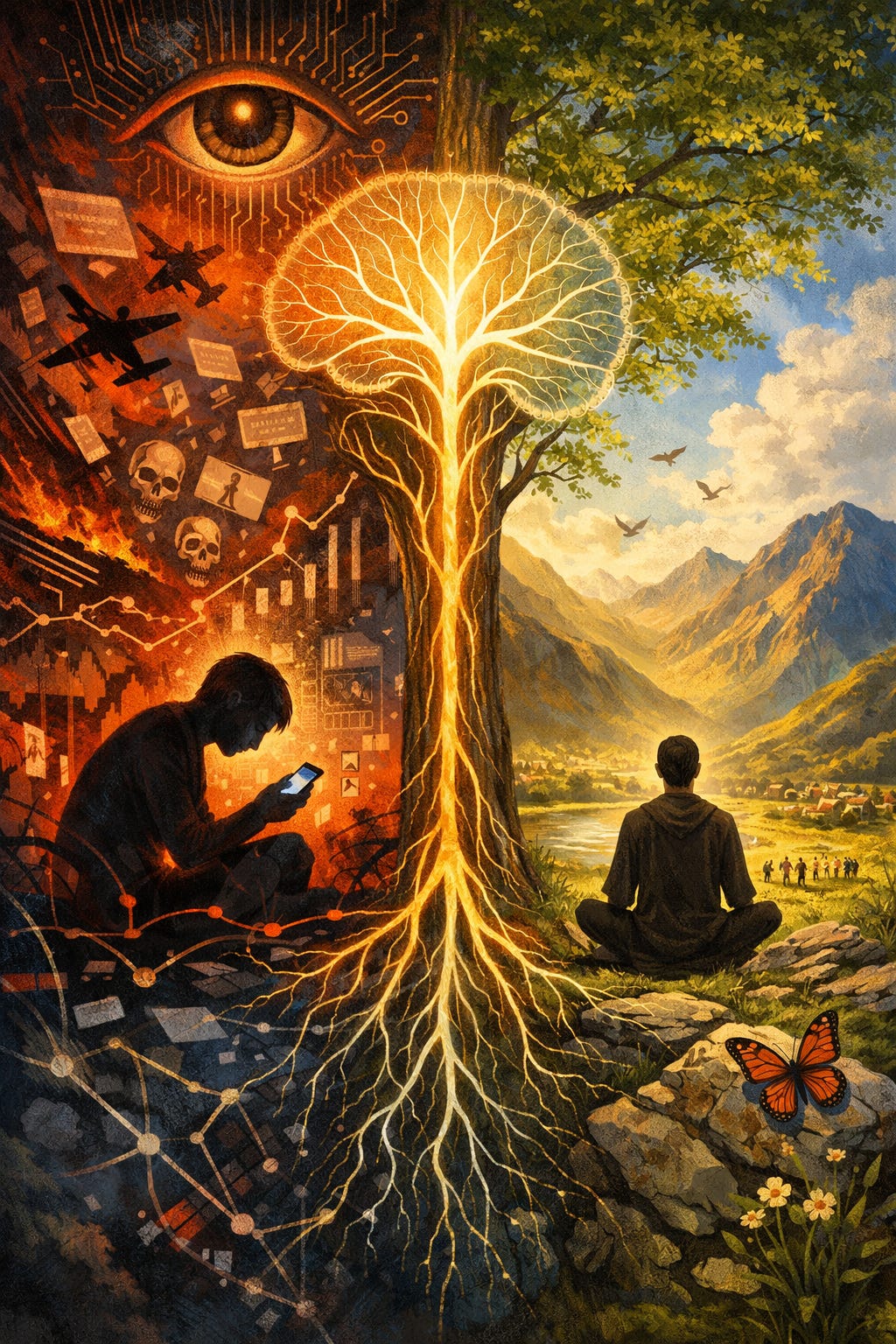
I’m sitting in Pisac. The Apus are out. An essay lands in my inbox — one of those well-researched, viscerally written pieces about Peter Thiel, Palantir, kill chains, blood transfusions, Antichrist lectures held in Roman palaces. Real content. Real stakes. And I feel my chest tighten, my breath shallow out, my shoulders climb toward my ears. The ancient valley holds steady. My nervous system does not.
I notice the split. I love this split.
Dr. Russell Kennedy would ask: is this alarm old, or new? Meaning — is what I’m feeling a response to this moment, or is this moment just a fresh hanger my body keeps finding for a coat it’s been carrying since childhood? Usually, honestly, some of both.
Either way, the essay is doing exactly what it was built to do.
The trick
A confession: I thought I was staying informed.
That’s the trick. The whole apparatus of algorithmic outrage dresses up as civic engagement. You’re not scrolling — you’re witnessing. You’re not dysregulated — you’re awake. You’re not being farmed — you’re being a responsible person. It’s elegant. It’s flattering. It also leaves you unable to feel your feet.
There’s a paradox worth sitting with: the same essay warning about AI as an instrument of mass psychological capture arrives through... a feed optimized by AI for psychological capture. The medium laughs at the message. Marshall McLuhan in the Cusco afternoon.
Here’s what I think is happening. The machine doesn’t need us to agree with it. It needs us dysregulated. Reactive, isolated, spiky, certain. A jacked-up nervous system is a monetizable nervous system — whether it’s buying fear-based products, forwarding rage-bait, or just generating more data as it thrashes. The threat response is the product.
Which means one of the most radical, unglamorous things a person can do in 2026 is be regulated.
The quieter katechon
I used to think leadership in hard times meant being louder. Sharper analysis, hotter takes, more urgent calls to action.
I’ve revised.
The people I actually trust to lead in times like these are not louder. They are steadier. They’ve done enough of their own work that their nervous systems don’t leak panic into the room. When they speak, other bodies settle. That settling is the leadership. The content is almost secondary.
Thiel, in his Antichrist lectures, invokes an old idea — the katechon, the biblical restrainer. The one who holds back the coming chaos. He casts himself (conveniently) as the katechon, arguing that defiant tech acceleration is what keeps totalitarian collapse at bay.
I want to propose a quieter katechon. A less flattering one.
The person who holds back collapse is maybe not the disruptor refusing oversight. Maybe it’s the friend who takes your call. The woman who hosts the dinner. The man who organizes the grief circle. The neighbor who actually knows your name. The teacher who stays embodied through the lesson. The elder who can sit with contradiction without flinching.
Katechon as shared nervous-system regulation. Restraint as relational capacity.
That’s infrastructure the palantír economy can’t see or datafy. It shows up in calendars and potlucks and long walks, not dashboards.
What the valley knows
I’m in the Sacred Valley looking at land. I’m also thinking about summers in British Columbia — roots north and south, two growing seasons, two jurisdictions, two watersheds.
It’s not escape. It’s planting.
Both places have long histories of being somewhere humans came to live when the empire got ugly. The valley remembers. The coast remembers. They’ve seen this movie before. They don’t need my panic.
A small practice
So here’s the counter-spell. It’s not exciting. It’s not viral.
Next time a piece of urgent content lands in your feed — before you react, before you share, before you comment — try this:
Feel your feet. Notice your breath. Ask Kennedy’s question: is this alarm old, or new? Then ask one more: what does my regulated nervous system want to do with this information?
If the answer is “text a friend and go for a walk” — that is not avoidance. That is leadership.
If the answer is “write something from ground, not from spike” — that’s leadership too.
If the answer is “do nothing with this and go hold my partner” — especially that.
The machine wants you jacked up and alone. Almost everything good about being human happens when you’re regulated and together.
That’s the work. That’s the whole thing.